
The Psoas Muscle: Why Stretching Your Hip Flexors Can Relieve Lower Back Pain and Improve Mobility
chiropractic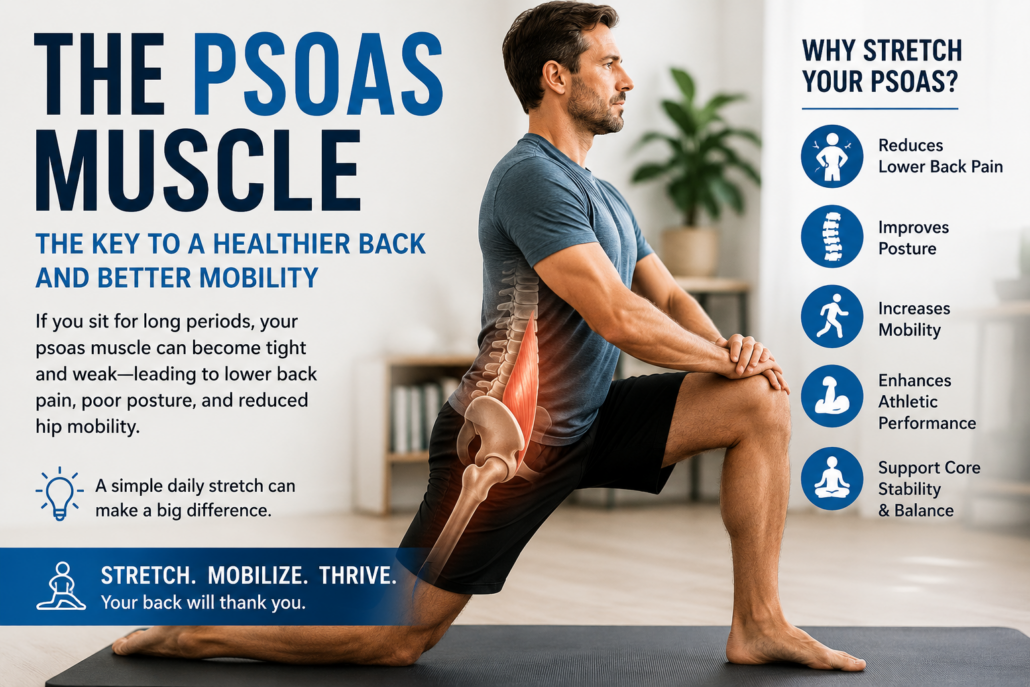
Why Stretching Your Psoas Muscle Could Be the Secret to a Healthier Back and Better Mobility
If you spend hours sitting at a desk, driving, or simply don’t move as much as you’d like, one muscle deserves far more attention than it gets: the psoas muscle (pronounced so-az).
Often called the body’s “hidden hip flexor,” the psoas plays a critical role in walking, standing, posture, balance, core stability, athletic performance, and lower back health. Yet it’s one of the most overlooked muscles when it comes to stretching and injury prevention.
What Is the Psoas Muscle?
The psoas is a deep muscle that begins along the front of your lumbar spine (lower back) and travels through your pelvis to attach to the inside of your upper thigh bone (femur). Along with the iliacus muscle, it forms the iliopsoas, your body’s primary hip flexor.
Every time you:
- Walk
- Climb stairs
- Run
- Lift your knee
- Get out of a chair
…your psoas is working.
Why Sitting Tightens the Psoas
Modern lifestyles keep many of us seated for eight or more hours every day. When you’re sitting, your hips stay in a flexed position, causing the psoas to remain shortened.
Over time, this can lead to:
- Lower back pain
- Hip tightness
- Poor posture
- Reduced flexibility
- Limited range of motion
- Difficulty standing fully upright
- Muscle imbalances
- Increased stress on the lumbar spine
This is one reason prolonged sitting is sometimes referred to as “the new smoking” when discussing overall health.
Benefits of Stretching the Psoas Muscle
Adding a simple psoas stretch to your daily routine can make a noticeable difference.
Improve Lower Back Health
A tight psoas can increase tension on the lumbar spine. Restoring normal flexibility may reduce stress on the lower back and improve overall movement.
Increase Hip Mobility
Flexible hip flexors allow your hips to move more naturally, making walking, running, squatting, and exercising easier.
Improve Posture
When the psoas is overly tight, it can contribute to an exaggerated arch in the lower back and forward pelvic tilt. Stretching helps promote better alignment.
Boost Athletic Performance
Whether you’re a runner, golfer, cyclist, tennis player, or simply enjoy staying active, healthy hip mobility can improve stride length, movement efficiency, and power generation.
Reduce Muscle Compensation
When the psoas becomes tight, surrounding muscles—including the lower back, glutes, and hamstrings—often work harder to compensate. Improving psoas flexibility can help restore more balanced movement patterns.
Support Healthy Aging
Maintaining hip mobility is one of the best ways to preserve independence as we age. Good flexibility helps with balance, walking, and reducing stiffness that can limit everyday activities.
How Often Should You Stretch?
Most people benefit from stretching the psoas daily, especially if they spend much of the day sitting.
Hold each stretch for 10–30 seconds, repeat on both sides, and avoid bouncing. Stretch only until you feel a gentle pull—not pain.
Consistency matters far more than intensity.
A Simple Habit That Pays Off
You don’t need an hour-long stretching routine to experience benefits. Just a few minutes each day devoted to improving psoas flexibility can help your body move more efficiently and comfortably.
If you’ve been dealing with hip tightness, lower back discomfort, or stiffness after sitting, your psoas may be asking for attention.
Your body was designed to move. Giving this important muscle the flexibility it needs is one simple step toward better posture, improved mobility, healthier movement, and long-term spine health.
Disclaimer: This article is for educational purposes only and is not intended to diagnose or treat any medical condition. If you have persistent pain or an existing injury, consult a qualified healthcare professional before beginning any new stretching program.
Dr. Ken Best, D.C.
ManyLevels Healing®
By Appointment Only
Los Angeles, California
- About Dr. Ken Best
- Applied Kinesiology
- Sciatica
- Herniated Discs
- Psoas Muscle
- Neck Pain
- Sports Injuries
- Laser Therapy
- Posture
- Contact
- Book Appointment
- Blog
Also link back to this page from each of those articles to reinforce it as the hub for the topic.
Use a few authoritative references to support educational content:
National Institute of Arthritis and Musculoskeletal and Skin Diseases (NIAMS)
Back Pain Information
https://www.niams.nih.gov/health-topics/back-pain
American Academy of Orthopaedic Surgeons (AAOS)
OrthoInfo Patient Education
https://orthoinfo.aaos.org/
Back Pain
https://orthoinfo.aaos.org/en/diseases–conditions/low-back-pain/
Neck Pain
https://orthoinfo.aaos.org/en/diseases–conditions/neck-pain/
American Physical Therapy Association (APTA)
ChoosePT (Patient Education)
https://www.choosept.com/
Guide to Back Pain
https://www.choosept.com/guide/physical-therapy-guide-low-back-pain
Suggested YouTube & Social Links
Embed or link to:
- YouTube: https://www.youtube.com/@manylevels
- Instagram: https://www.instagram.com/drkenbest
- TikTok: https://www.tiktok.com/@drkenbest
